
Other public pension funds screen out risky stock investments such as fossil fuels and private prisons. Why doesn’t the Oregon Treasury?
Photo by Héctor Berganza / Pexels
Other public pension funds screen out risky stock investments
such as fossil fuels and private prisons.
Why doesn’t the Oregon Treasury?
This blog continues our effort to answer the questions raised in recent blogs, such as in our May 19, 2026 blog:
There is a “growing movement” of pension funds divesting from private prison companies.
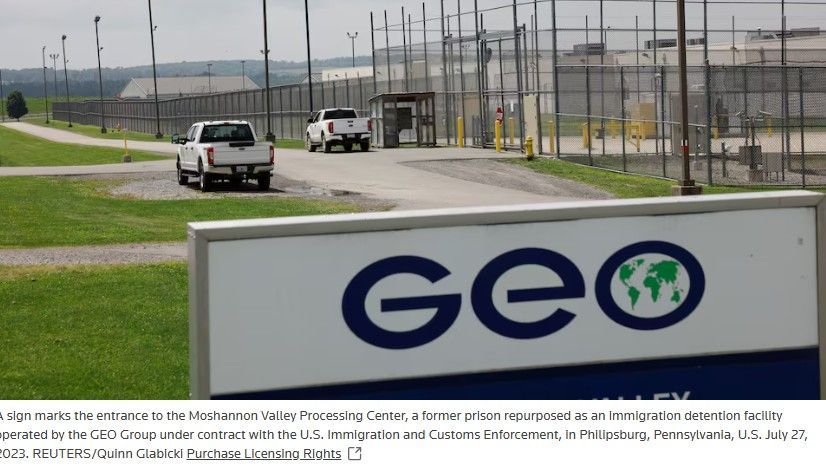
- CalPERS: “California’s public pension system just pulled $400 million from private prison companies, joining a growing movement…. The California Public Employees’ Retirement System (CalPERS) cited human rights concerns and financial risks as driving factors behind their decision to divest from CoreCivic and GEO Group, the nation’s largest private prison operators.” (2026)
- New Mexico Teachers: “We’re a pension fund that represents educators, and I think the message that we received from our members has clearly indicated that they have a very strong distaste for our investment in private prisons.” (2020)
- New Jersey: State officials cited ethical concerns about profiting from incarceration. (2020)
- New York State: Determined the investments posed “long-term financial risks.”(2018)
- New York City: “...we’re seeing more and more industries try to profit from backwards policies at the expense of immigrants and communities of color…. An analysis conducted by the [NYC] comptroller’s office and outside consultants also found inherent investment risks in for-profit prison companies. ‘The issues surrounding private prisons,’ said Stringer, ‘can lead to reputational, legal, and regulatory risks, which could “seriously harm” investors.’” (2017)
Scott Stringer, as NYC Comptroller, made the case for others to join the private prison divestment in the New York Times, (7/30/2018) in a co-authored piece: More Cities and States Should Divest From Private Prisons.
Why are these risky stock investments?
- Litigation Risk: “...new state and local regulation, recently levied tax liabilities, and new and ongoing litigation stemming from allegations of mismanagement, chronic understaffing, health and safety risks, and labor law violations, to name a few.” A quarterly private prison investor risk brief (Robert and Ethel Kennedy Human Rights Center 5/13/2026)
- Operational Risks in Abusive and Costly Operation: “The private prison executives who run 90 percent of immigration detention personally pocket millions in public funds by cutting costs through understaffing, overcrowding and denying minimum services like suitable food and medical care…. These ICE facilities aren’t just abusive. They’re also ineffective and wasteful. While community-based alternatives to detention like case management programs cost only $14 a day per participant and have returned a 100 percent court appearance rate, detaining one adult immigrant costs more than $160 a day.” (Commentary in the New York Times 4/23/2025.)
- Push back from labor unions and other beneficiaries:
- Since 2018, AFT has highlighted the investment risks to pension funds whose portfolios contain exposure to the private prison industry or contractors who provide services to immigration detention centers. Private Prisons, Immigrant Detention and Investment Risks, (2018); Private Prisons and Investment Risks, (2020)
- SEIU’s Verrett Condemns House Vote, Urges Senate to Reject Immigrant Incarceration Bill (SEIU 1/8/2025)
- AFSCME fights back as private prison corporation asks Supreme Court for a shield from accountability (AFSCME 9/23/2025)
What are past Treasury statements on its public equity stock market investment practice, using private prisons as an example?
A 2019
Chief Investment Officer
article, on criticism of the Oregon Treasury’s private prison and surveillance technology investments, included the Treasury’s position:
Oregon State Treasurer Tobias Read said in a statement that these investments are captured via index, and noted the pension has no ontrol over what sorts of companies are included or disengaged from the index. By fully repealing themselves from the index investment, Oregon will “incur costs that violate the ‘paramount objective’ of making money,” the AP said the treasurer’s office stated.
Years later, in a May 6, 2026
Facebook post, Treasurer Elizabeth Steiner said she was “deeply troubled about Geo Group’s practices,” describing Geo Group as a “private prison company that also contracts with ICE.” She specifically called out “concerns about the company’s governance and the Geo Group leadership’s failure to adequately respond to operational risks related to the facilities it manages.” Treasury then stated that, since “Oregon does not pick the companies it holds in passively managed funds,” “Treasury will use our shareholder votes to demand higher ethical standards and greater accountability from the company to address the numerous risks posed by their business model.”
Let’s sum up:
- Former Treasurer Read said they have “no control” over index funds in which they invest; Treasurer Steiner says Treasury “does not pick the companies it holds in passively managed funds.”
- OIC investment policy says the Treasury must integrate systems, including proxy voting, to evaluate and monitor environmental, social and governance (ESG) risks. It relies on Treasury staff to assess these named risks, but does not require them to do anything.
- Treasurer Steiner calls out a company in whose stock Treasury invests because it does not meet governance standards and fails to respond to operational risks.
- These risks have financial impact on the portfolio, as discussed above.
- The Treasurer chooses engagement with the company and voting in a shareholder meeting as Treasury’s response to a company’s governance failure. However engagement:
- Requires screening stock to identify problematic companies.
- Takes significant staff time.
- Needs divestment as an outcome if demands are not met to to be on the table to be credible. Engagement and divestment: Shareholders transcend a false binary. (IEEFA 9/12/2024)
- Other pension funds have chosen the direct route: exclude stocks that fall outside of defined criteria.
- Possible alternatives available to the Treasury: use a customized index fund created specifically for the Oregon Treasury or a focused index fund such as the S&P 500 Fossil Fuel Reserves Free Index.
What about the 2025 legislation crafted by the Treasurer?
The Climate Resilience Investment Act (CRIA), a bill introduced by Treasurer Steiner, demands portfolio fossil fuel emission reduction. The Treasury invests in multiple index funds, listed below, such as the S&P 500 and the BlackRock Russell 3000.
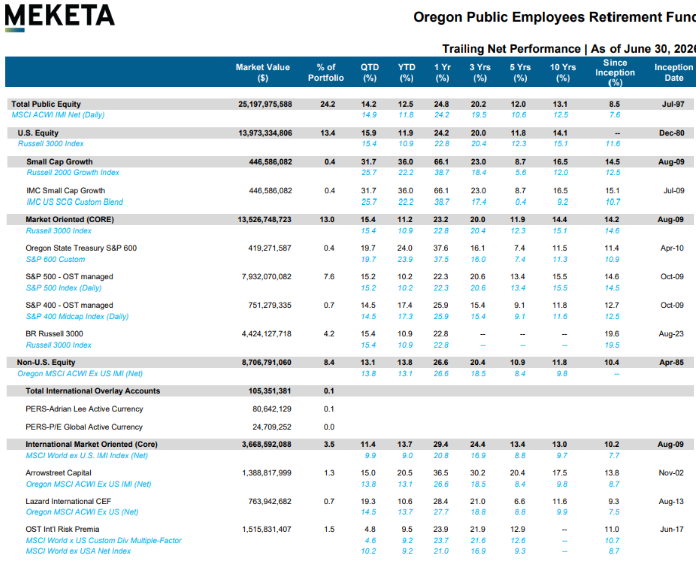
The S&P 500 index, in which the OST holds $7.9 billion, is a weighted index of 500 leading US companies’ common stock. By definition, there is no screening or selection of those stocks other than by their market size, liquidity and industry group representation.
The
BlackRock Russell 3000 Index,
in which the OST holds $4.4 billion, tracks the performance of the 3,000 largest publicly traded companies in the United States. By choosing this index fund, OST invests in about 98% of the investable U.S. stock market.
In the index are 66 Oil & Gas companies, including such majors as ExxonMobile and Chevron.
The Oregon State Treasury has chosen a broad diversification policy and engagement. It has the option of custom indices or divestment to keep risky stock out of the portfolio. The legislature recently granted enhanced staffing to the Treasury which can be shifted from could be used to screen out risky stock instead of pursuing engagement as a strategy. It is long past time to screen investments for risk and to interpret CRIA to eliminate fossil fuel holdings quickly.
_______________
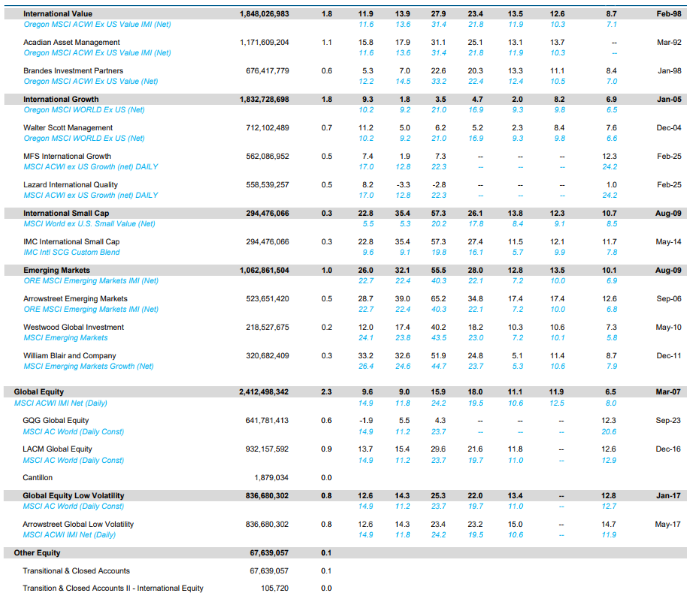
Note: Below are funds OST is using for Public Equity from September 2026 OIC public book, p 50. Biggest shares of public equity are held in an internally managed US equity funds: “S&P 500 - OST managed” (about 30%) and an externally managed fund “BR Russell 3000” (17%).





Oregon State Treasury should engage or divest from companies fueling a new era of resource conflicts