
When Will the Oregon Treasury Comply with the COAL Act?
When Will the Oregon Treasury Comply with the COAL Act?
Divest Oregon’s COAL Act passed in 2024. The statute mandates annual reporting by the Oregon State Treasury (OST) to the Legislature “on actions taken pursuant to the act.”
The COAL Act spells out that OST can only remain in a thermal coal investment if the company is transitioning to clean energy on a reasonable timeline. A full report under the COAL Act would document where each coal company is in its transition process, when OST expects it to be completed, and actions that will be taken if the transition is not occurring.
The Treasury’s
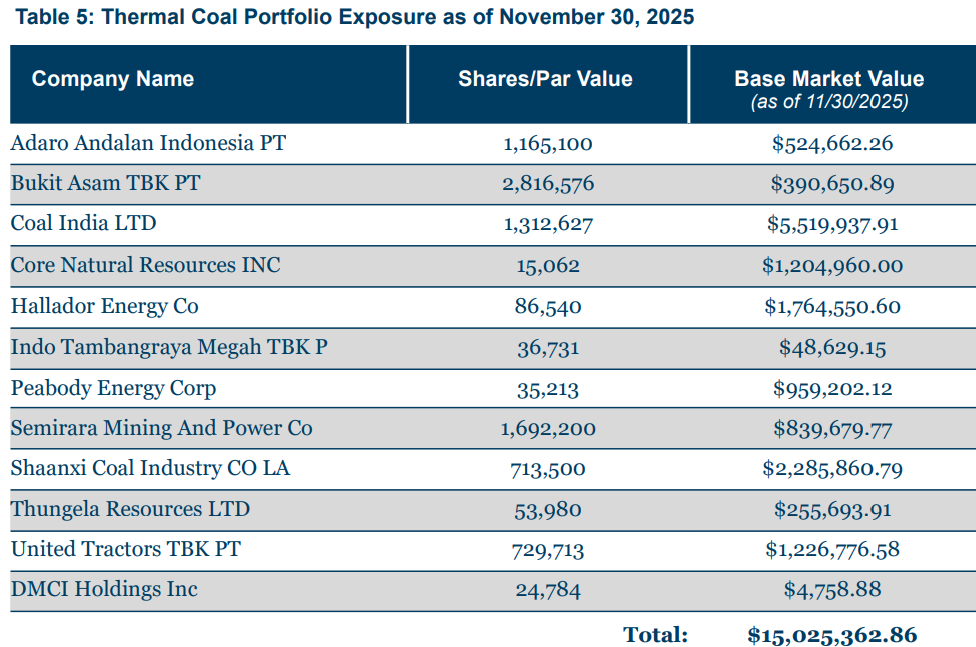
2025 Net Zero Plan Progress Report does not comply with the statute. Table 5, shown below, was presented with this text:
Staff determined that as of November 30, 2025, the portfolio had $15 million worth of investments in 12 securities identified as “Thermal Coal” companies, a decrease from $28,979,710.04 worth of investments in 21 securities reported by staff in 2024. p. 26
Divest Oregon promptly
pointed out (p. 16) the contrast between the report and the statute.
Before we look more closely at what the Treasury should report under the statute, let’s ask these common sense questions about the last report:
- Is the reported decrease in thermal coal holdings due to action by the Treasury or just market forces?
- Looking at the largest coal companies in the Treasury Public Equity stock portfolio, as examples, do these companies look like they are transitioning to clean energy to you?
- Bukit Asam TBK PT (Oregon Treasury holds 2,816,576 shares). Linkedin page: “...a state-owned company that aims to develop the national mining industry, particularly coal mining. Founded in 1981, the company is one of the five largest coal producers in Indonesia…[w]ith mineable reserves of approximately 8,27 billion tons.”
- Semirara Mining And Power Co (1,692,200 shares). Website: “...the largest coal producer in the Philippines, and the only power producer in the country that owns and mines its own fuel source.”
- Coal India Ltd (1,312,627 shares). Wikipedia: “...an Indian state-owned coal mining company…. It is the largest coal producer in the world by output…”
(The
most recent data available to the public is OPERF stock holdings as of 6/30/2025, so the public has no way to know what the Treasury is holding as of October 2026.)
The next OST report, due by January 15, 2027, needs to show
actions taken to comply with these statutory provisions:
The Treasury must screen ALL its investments – including investments held in private funds such as private equity holdings – and “try to ensure” no thermal coal investments:
- The State Treasurer shall make reasonable efforts to investigate all companies in which the State Treasury has invested or may invest PERS funds to identify thermal coal companies. (Section 3(1))
- The State Treasurer shall try to ensure that moneys in PERS (section 1(4)) are not invested in any thermal coal company, or any fund containing a thermal coal company (section 2(1)).
- An effective screen would exclude any additions of thermal coal stock to PERS unless there is also a transition to clean energy plan for each holding, with a timeline.
The Treasury must end its investment in any publicly traded thermal coal company OR monitor the company to ensure it is transitioning to clean energy on a reasonable timeline:
- The State Treasury shall give notice to any publicly traded, thermal coal company in which it is invested that the Treasury will end its investment unless the company demonstrates that it is transitioning to clean energy on a reasonable timeline (Section 3(2) and Section 3(4)(a)) and shall monitor compliance (Section 3(4)(c))
- Compliance with the law would mean divestiture of stocks now held that are not conforming to the timeline of an established plan to transition to clean energy.