
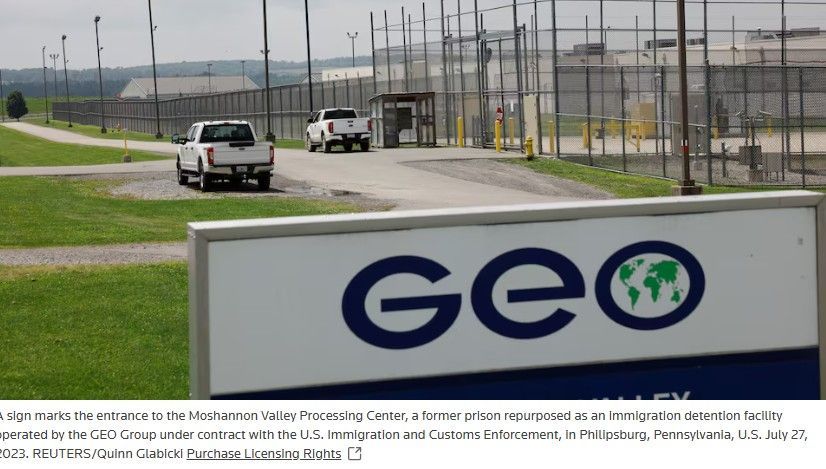
Treasurer Steiner is “deeply troubled” about ICE contractor Geo Group… but OST has been a shareholder for years.
A Geo Group van leaving the the Northwest ICE Processing Center in Portland Oregon. May 2026
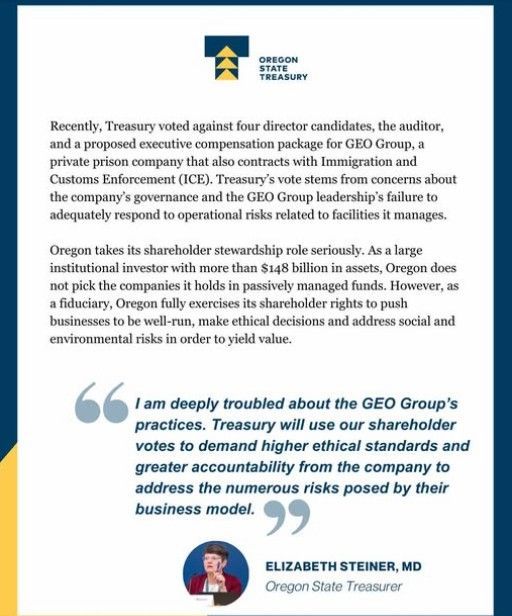
It is commendable that Treasurer Steiner posted acknowledgement on Facebook (shown below) that Geo Group, a private prison company that also contracts with Immigration and Customs Enforcement (ICE), is a problematic and risky investment. She cited proxy voting against 4 director candidates as the Treasury's response to these risks. However, shareholder engagement is inadequate.
Why has the Treasury held stock for years in Geo Group when:
- The Treasury has “concerns about the company’s governance.”
- The Treasury has “concerns about the company’s leadership failure to adequately respond to operational risks related to the facilities it manages.”
- The Treasury acknowledges “the numerous risks posed by their business model.”
- Divest Oregon has published reports dating back to 2023 asking whether the Treasury has any screening process for stock investments. The reports focused on the multiple harms of fossil fuel investments, but private prison companies Geo Group and CoreCivic, and surveillance technology firms including Palantir, were cited as clear examples of screening failure.
- PERS beneficiaries have questioned the types of investments Oregon State Treasury is making for even longer; see AFT’s 2018 report Private Prisons, Immigrant Detention and Investment Risks.
Treasury relies on contracted asset managers to invest through passively managed stock portfolios, which can be customized.
Treasurer’s 2025 Net Zero Progress Report says: “When conducting due diligence about potential managers, staff examine a manager's philosophy and approach to integrating ESG (environmental, social, governance) factors into the investment process. OST expects managers to have a systematic method for identifying and assessing material ESG risks and opportunities.” A presentation to the Oregon Investment Council 1/22/2025, pp 136-7, references an “ongoing review process” of managers.
Treasury standards for asset managers require identifying and screening out companies with leadership failures that create operational risks. Why then is the Treasury invested in private prison companies that:
- keep detainees in inhumane conditions, without adequate food, water or medical care, in overcrowded facilities without proper sanitation or sleeping accommodations
- separate children from parents: See New York Times 5/17/2026 article "Over 100,000 Family Separations in Deportation Push, Report Estimates" to understand the scope of the effort private prison companies enable. The Brookings Institution researchers estimated that 205,000 children have had a parent detained.
- fail to provide detainees due process in multiple ways
- cut off detainees from family and legal counsel, in part through a routine practice of quickly moving detainees out of state
- are legally responsible for their conduct even if under orders from the federal administration
- operate under a business model that creates profit through:
- paying approximately half of the 60,000 detainees, held under civil rather than criminal law, $1 for a day’s labor
- a high per person/per day charge, paid by taxpayers, that incentivizes extended detention.
For source citations, see: Why is the Treasury still investing workers’ retirement in fossil fuels, ICE contractors, and surveillance technology? (Divest Oregon, March 17, 2026)
The Treasury says it selects and monitors its contracted asset managers. OST’s fund size alone means it has the clout to dictate the companies its outside asset managers invest OPERF in or, in this case, avoid. Why does the Treasury invest in companies whose business model relies on lawlessness, despair, and death to drive up their profit?


Oregon State Treasury should engage or divest from companies fueling a new era of resource conflicts